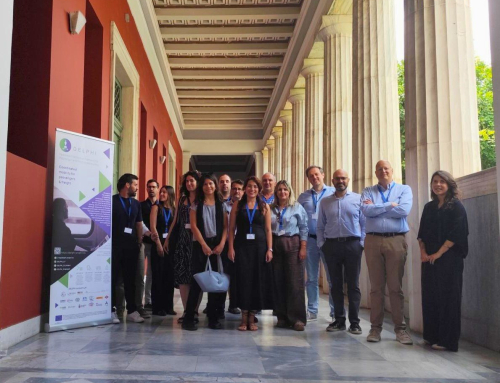

Meet MOBILYSIS
MobiLysis is an EPFL spin-off focusing on urban mobility. Our team is dedicated to advancing sustainable and inclusive transportation systems. With expertise in drone-based data collection, mobility analytics, traffic modeling,, and AI-powered optimization tools, MobiLysis contributes innovative solutions to real-world mobility challenges. The team is composed of engineers and researchers who combine academic excellence with entrepreneurial spirit to support public and private stakeholders in shaping the cities of tomorrow.
Can you provide an overview of your role and involvement in the DELPHI project?
MobiLysis leads key technical tasks in WP4 of DELPHI, particularly in the development of optimization frameworks for integrated passenger and freight transport, environmental modeling through multi-sensor data fusion, and AI/ML-based decision support for predictive traffic management. Our contributions include the design of data collection campaigns using drones, the extraction and analysis of high-resolution vehicle trajectories, and the development of algorithms that balance mobility efficiency with sustainability goals. We also support the Athens, Madrid, and Mykonos use cases, providing input through drone experiments and emission modeling.
What are some challenges you encounter as part of your work with the DELPHI project?
One major challenge lies in aligning drone flight operations with technical and legal constraints while maintaining high-quality data output. Weather conditions, flight permissions, and battery limitations must all be considered. Ensuring precise vehicle tracking and speed estimation also requires careful post-processing and validation. Another challenge we see is the integration of different data types demands rigorous cleaning, alignment in time and space, and the development of robust data fusion algorithms. While it is a technically demanding process, it is crucial for validating emission models and improving their generalizability across different urban contexts.
What is your future perspective in relation to the DELPHI topic?
We see a growing role for lightweight, flexible, and privacy-preserving monitoring technologies like drones in shaping urban mobility policies. As cities move toward decarbonization and multimodal transport systems, the integration of data from drones with AI-powered analytics will be instrumental in enabling responsive decision-making.
Is there anything else you would like to mention or highlight?
We love the collaborative nature of DELPHI as it is crucial for cross-disciplinary innovation. Working alongside transport and logistics operators, infrastructure managers, and research institutions has provided us with unique insights into the complexities of diverse urban mobility systems. We look forward to continuing this work and sharing our findings with the broader community.